


November 9, 2007
Guatemalan Units of Measurement
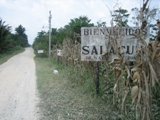
Guatemalans use the metric system, but they are still kind of trapped between rural farmers who still use their traditional units of measurement and influence from US English units. You buy gas by the gallon, drive stretches of road in kilometers, and you plant corn by the cuerda. Below is a list of distance and area measurements used in Salacuim, Guatemala.


November 8, 2007
Scholarship Exam
We had a great turnout for the scholarship test that was given this week to all students in Salacuim that had completed 6th grade and have the desire to continue studying in 7th grade next year. The reality is that about half of these students won't be able to go to school next year, and essentially all of them will have difficulties finding money to buy supplies or uniforms.
So for many of these kids, doing well on this test and winning a scholarship through this program is the only chance they have to study next year.
Although several scholarship students will be grandfathered in this year, new students will all come from this group. The program hopes to select about 5 new scholarship students, depending on the success of fund-raising.
We are especially proud of how much the community collaboration has developed in a year. Last year, Kari and I picked scholarship students based on personal relationships and perceived needs. Right now, we have the support of teachers, community organizations, and of course the small committee that will be in charge of management after we leave; all supporting the dream to create a small, sustainable program that will create opportunities for children and develop leaders.


So for many of these kids, doing well on this test and winning a scholarship through this program is the only chance they have to study next year.
Although several scholarship students will be grandfathered in this year, new students will all come from this group. The program hopes to select about 5 new scholarship students, depending on the success of fund-raising.
We are especially proud of how much the community collaboration has developed in a year. Last year, Kari and I picked scholarship students based on personal relationships and perceived needs. Right now, we have the support of teachers, community organizations, and of course the small committee that will be in charge of management after we leave; all supporting the dream to create a small, sustainable program that will create opportunities for children and develop leaders.
November 2, 2007
Something to Think About
With only five months left of service, I find myself trying to understand the situation Guatemala is in and what my future role can be. There is a strange feeling in knowing that I will someday leave and go back to a fairly comfortable lifestyle. I often feel guilty and at times very excited. It's a difficult balance. After living in Salacuim for nearly 2 years, I truly feel concerned for the people of my community and wonder what their future holds.
Currently Guatemala has the highest percentage of people living below the poverty rate in all of Central America at 56.2%. Extreme poverty is defined as living on less than $1 a day and moderate poverty is less than $2 a day.
Here are some interesting comparisons between Guatemala and the U.S.
Guatemala/United States
Illiteracy rate: 30.9%/1%
Infant Mortality rate: 29.7 of 1,000/6.27 of 1,000
Fertility rate: 3.7 per woman/2.09 per woman
HIV prevalence: 1.1%/0.6%
Population below poverty level: 56.2%/12%
Age structure: 1-14(40.8%) 15-64(55.5%) 65+(3.6%)/
1-14(20.2%) 15-64(67.2%) 65+(12.6)
Other Guatemalan Facts...
Average duration of schooling is only 4 years
Only 3 of 10 children graduate from 6th grade
More than 2 million children do not attend school
(mostly indigenous girls in rural areas)
Infant mortality rate is the highest in Central America and the 3rd highest in the hemisphere
50% of Guatemalan women have given birth before the age of 19
20% have 2 or more children by their 18th birthday
Contraceptive prevalence is 43%, the 2nd lowest in the hemisphere
49% of Guatemalan children under the age of 5 are chronically malnourished
Only 41% of births are attended by a doctor or nurse, lowest in the hemisphere
information provided by www.cia.gov, www.usaid.gov
Currently Guatemala has the highest percentage of people living below the poverty rate in all of Central America at 56.2%. Extreme poverty is defined as living on less than $1 a day and moderate poverty is less than $2 a day.
Here are some interesting comparisons between Guatemala and the U.S.
Guatemala/United States
Illiteracy rate: 30.9%/1%
Infant Mortality rate: 29.7 of 1,000/6.27 of 1,000
Fertility rate: 3.7 per woman/2.09 per woman
HIV prevalence: 1.1%/0.6%
Population below poverty level: 56.2%/12%
Age structure: 1-14(40.8%) 15-64(55.5%) 65+(3.6%)/
1-14(20.2%) 15-64(67.2%) 65+(12.6)
Other Guatemalan Facts...
Average duration of schooling is only 4 years
Only 3 of 10 children graduate from 6th grade
More than 2 million children do not attend school
(mostly indigenous girls in rural areas)
Infant mortality rate is the highest in Central America and the 3rd highest in the hemisphere
50% of Guatemalan women have given birth before the age of 19
20% have 2 or more children by their 18th birthday
Contraceptive prevalence is 43%, the 2nd lowest in the hemisphere
49% of Guatemalan children under the age of 5 are chronically malnourished
Only 41% of births are attended by a doctor or nurse, lowest in the hemisphere
information provided by www.cia.gov, www.usaid.gov
October 16, 2007
Laguna Lachuá National Park Brochure
It's been over a year in the making, several rough drafts and months waiting for funds, but finally the new park brochures are finished and should be printed soon. Even though Laguna Lachuá has been a national park for over 37 years, very few promotional materials exist. This may be one of the reasons it remains one of the least visited parks in all of Guatemala. We hope that by distributing brochures and posters to all the major travel agencies in the country, it will encourages some tourists to take the long journey to check out, what we would consider, one of the most beautiful areas in Guatemala.


October 15, 2007
Ecoregión Lachuá
Ecoregión Lachuá is where we work. Kari made this map as part of some new eco-tourism promotional material.

October 14, 2007
Álvaro Colom Visit to Salacuim
Guatemala is in the heat of a campaign leading up to it's presidential elections on November 4. Salacuim history was made today when this small aldea of 2,500 people received its first ever presidential campaign visit from Álvaro Colom. He came in a helicopter, talked for about an hour and then his team accepted letters of request from community members seeking community projects if he were to become president. Afterwards, there was squabble around the truck that was throwing out 50 cent bags of kool-aid and little pieces of bread to the locals.

October 12, 2007
Carpe Diem Visit to Lachuá
Last week we had the good fortune to be hosts to a group of 15 Americans that came for a week long visit to Laguna Lachuá and Salacuim. They came with a ton of energy and willingness to contribute to community projects in the area. They were in week 4 of a 3 month long trip through Guatemala, Honduras, and Costa Rica (link to their blog); all of them learning to speak Spanish and doing community service along the way. I think they all really enjoyed being in our area: visiting the Laguna Lachuá Park, learning about the hand made weaving from TESA (women's group that Nicole works with), working really hard pouring a cement floor in the youth group construction project, harvesting corn with a local farmer, helping to clear weeds from a reforestation project, sifting dirt for the tree nursery, and helping out on a Tilapia farm.
We felt lucky to host such an active group and watched a wonderful exchange of cultures between the locals and the visitors. Most of all I also enjoyed playing in a competitive basketball game with people taller than me.

Helping mix concrete by hand

Learning how to weave
We felt lucky to host such an active group and watched a wonderful exchange of cultures between the locals and the visitors. Most of all I also enjoyed playing in a competitive basketball game with people taller than me.
Helping mix concrete by hand
Learning how to weave
October 8, 2007
Trip to Chiapas, Mexico
We've been bogged down with work lately and feeling like our "Close of Service" date that is only about 6 months away is looming, as we're trying to complete various projects. I recently finished up a community tourism training class with a group young people from the neighboring town of Benpec el Castaño which had been keeping us tied down every Saturday for the last few months. We are also pushing to finish a construction project, where the local youth group (JAGUAR) is adding on a study space to their community library. We are in the thick of organizing the scholarship program for the school year that starts next January. Kari is busy with designing some eco-tourism promotional material and website improvements for the Laguna Lachuá National Park. Kari and Nicole have had a few meetings to try to create a young girls group to help promote leadership and self-esteem. Of course there are lots of other important community project ideas that have always been delayed, with the thought "we'll have more time for that later".
I'm also thinking about trying to soak up as much as I possibly can from our precious little remaining time....I've never taken the hike to Rocja Pomtila from Salacuim through the thick of the jungle, I haven't learned more than basic conversations in the Q'eqchi' language, we've never traveled to Xela on the other side of the country, I've only hiked up 1 of the 20 volcanoes higher than 2000 meters in Guatemala.
So, last weekend we made a quick get away to Chiapas, Mexico with our site mate Nicole. I had heard about a National Park called the Lagunas de Montebello that wasn't supposed to be very far from our site. We left early in the morning on Saturday and got to a town called Tziscáo in the afternoon. On the way we crossed the dusty, unmanned border crossing near the town of Ingenieros, Guatemala and spent the rest of the weekend wondering if anybody would check for a stamp in our passports. The Mexican side of the border greeted us with paved roads, a nearly empty micro-bus, and a semi-cautious driver (now that's what I call a developed country). The scenery was beautiful and we found a little cabin to stay at right next to a sweet little lake. Here are a few pictures from the trip....

Kari on one of the famous rafts made from the local cork trees.

View from 5 Lakes lookout

Kari and I at one of the lakes
I'm also thinking about trying to soak up as much as I possibly can from our precious little remaining time....I've never taken the hike to Rocja Pomtila from Salacuim through the thick of the jungle, I haven't learned more than basic conversations in the Q'eqchi' language, we've never traveled to Xela on the other side of the country, I've only hiked up 1 of the 20 volcanoes higher than 2000 meters in Guatemala.
So, last weekend we made a quick get away to Chiapas, Mexico with our site mate Nicole. I had heard about a National Park called the Lagunas de Montebello that wasn't supposed to be very far from our site. We left early in the morning on Saturday and got to a town called Tziscáo in the afternoon. On the way we crossed the dusty, unmanned border crossing near the town of Ingenieros, Guatemala and spent the rest of the weekend wondering if anybody would check for a stamp in our passports. The Mexican side of the border greeted us with paved roads, a nearly empty micro-bus, and a semi-cautious driver (now that's what I call a developed country). The scenery was beautiful and we found a little cabin to stay at right next to a sweet little lake. Here are a few pictures from the trip....
Kari on one of the famous rafts made from the local cork trees.
View from 5 Lakes lookout
Kari and I at one of the lakes
October 2, 2007
2008 Scholarship Program
As many of you know, we have been working with a community based organization to take over our responsibilities with the scholarship program when we complete our service in April of 2008. We will both still be very much a part of the program and the overall management, but will rely on the Salacuim committee to oversee the day to day administration and management.
We recently finished a website that illustrates all the details for the coming year.
We invite you to read and share in the success and possibility with us once again.
www.lachua.org/scholarships.html
We recently finished a website that illustrates all the details for the coming year.
We invite you to read and share in the success and possibility with us once again.
www.lachua.org/scholarships.html
Subscribe to:
Posts (Atom)

 Posts
Posts


