December 26, 2007

Christmas in Salacuim

After much debate of how and where we were going to spend Christmas this year, we finally decided to stay home and experience the holiday through the eyes of Salacuim. There were many events that led up to the day and we could feel the excitement in the air as Christmas Eve approached. About a week ago, Corby helped one of our neighbors, Don Ramon, wrestle a pig in a nearby community so that he could cook it for his Christmas dinner. Not very many people can afford to purchase an entire pig, which goes for about Q500 ($65), but he was planning on cooking the meat and selling it for all those that wanted a special treat.

100_4103
Corby and Don Ramon with the Christmas pig

For us, it is difficult to get used to a green Christmas, especially since we have been hearing about all the snow in Minnesota this year. We struggled to find creative ways to make it feel like Christmas while it was 80 degrees. Luckily, a large coconut tree feel down in our front yard a couple days before Christmas, which allowed us to use the palm branches for a makeshift tree- lights and all.

IMG_7041
Decorating the Christmas Palm

Christmas Eve is the biggest day of celebration for Guatemalans. We spent our day helping neighbors make the traditional meal of tamales, which consists of corn paste, a chile sauce and a small piece of chicken, all wrap up in a banana leaf. After being here for almost 2 years, I finally found myself liking the taste of tamales, but that has worn off over the last few days.

100_4152
Preparing tamales with the Prado family

We spent the evening at church with our friends and neighbors, singing the same Christmas songs as we sing in the states, only in Spanish. There were endless invitations afterward to join families in their homes for tamales. We were overwhelmed by the spirit of the season as people welcomed us and shared their food and company. Corby and I had a difficult time consuming 2 tamales at every house we went to and as a result we have over 10 sitting in the refrigerator right now.
At midnight people lined the main street, some sat with chairs in their front yard and everyone threw firecrackers. The entire town was alive with excitement. The Catholic church walked through town in a procession singing songs and people spent the rest of the night into Christmas Day with their families, eating and socializing.

IMG_7046
Catholic Procession through town

While we missed being with our own families at home, we look forward to next Christmas when we all will be together again and cherish the memories of Christmas in Salacuim. We are heading to Belize for the New Year and are looking forward to seeing a new part of Latin America.

¡Próspero Año!

December 19, 2007

2008 Scholarship Recipients

We are happy to announce that we have selected 5 new students to enter our program in 2008. About 6 weeks ago an exam was given to all 6th graders and the top scoring students were selected to participate in the Scholarships for Salacuim program. Each student has been offered a full 3 year scholarship to complete junior high in Salacuim as long as they complete the rules of the program and maintain their grades.

100_4093 100_4092 100_4091
The 5 newly selected students for 2008- all entering 7th grade
100_4090 100_4085

Our program this year will solely be focused at the junior high level, as the community committee takes over in our absence. We are also grandfathering in the 4 junior high students from last year that have successfully completed the 2007 school year.

This week we had our first meeting with the new students and their parents to introduce them to the program. We are really excited about this new group as we feel they have already proven their intellectual ability through the exam and are ready to tackle the challenges of 7th grade. They really seem like a great group of kids and we look forward to working with them in 2008!

100_4095
Russell, Reyna, Sherna, Maria, Jener

December 11, 2007

Cell Phones coming to Salacuim!

We've been hearing rumors for at least a few months now that the cell phone companies have been visiting the area around Salacuim and doing feasibility studies. Obviously, we've been anxious to see if the rumors are true. We've lived here for almost two years now, always with limited communication. There are a few public telephones that grab a cell phone signal with a large antenna from distant cell towers, but the result is always a scratchy connection and a 65 cent/minute charge to call the US. There is also a telephone at our NGO's office which works on a satellite connection, but its plagued by a 2 second delay and strict limits on personal calls (especially frustrating when speaking Spanish as a second language).

Also, about six months ago some new towers went up across the Chixoy River in the Quiche department that gave everyone a sort of hope that maybe their phones could grab signal in special "spots", in fact the large open field next to our house has had a faint signal if you stand in the right place for enough time and learn the tricks such as shutting-of and restarting your phone 3 times in succession while raising your left hand in the air. This ghost signal has created a culture of small groups that congregate in these "spots" with their phones every night, partially to make phone calls but also to pass time.

This is all about to change, as this week we noticed a large metal object growing in Salacuim's skyline, a shiny new cell phone tower! The rumor is that we will have real cell phone signal before Christmas. A team of 6 Colombian and Nicaraguan workers (better described as Trapeze artists) are throwing up a 130 meter tall tower that promises cheap, clear phone calls and the ability to actually receive calls in the last few months of our Peace Corps Service.

Construction Methods:
Although these guys don't have all of the safety gear required in the US, I'm impressed with their use of resources. There is no crane, but they can secure a metal section of ladder to the tower with rope and use it as a boom. From there they run a rope through a pulley system to the rear wheel of a pickup truck up on blocks. To lift sections of the tower, they start the pickup, put it in gear and use it as a crane.

Development:
An adviser to our NGO talks about development of the area as a balance between infrastructure, education, political organization, and environmental conservation; calling them the 4 "capitals". Things like education and political organization are just as important to the development of Salacuim, but they are intangible, hard to see, and actually take more time.

Infrastructure, however, is very tangible and visible. We arrived in Salacuim about 10 years after they were connected to Cobán with a gravel road. The electricity came about 4 months before we arrived, and a previous Peace Corps volunteer told us about the drastic difference: TV's, later nights on the street, etc. Earlier this year, all of the side streets were leveled and lined with gravel; a huge improvement to the steep, slippery paths of before. Offices have also been built for the local organizations: the youth group, the farmers group, and the womens group. In the near future, running water and road paving projects are in the works. We have to look at how much the face of this area is changing and just be amazed.

100_4053
Tower construction acrobatics

100_4059
The tower construction site is the most popular community gathering spot

100_4045
Use of pick-up as a crane


December 1, 2007

Lunch with the Senators

During Joey and Stacie's visit, we got a phone call from the Peace Corps office inviting us to have lunch with a delegation of US Senators that were in the midsts of a tour, meeting with presidents of several South American and Central American countries during the Senate's Thanksgiving recess. Only 6 Peace Corps volunteers were invited, including us because I happen to be the only PC volunteer in Guatemala with North Dakota roots and both senators from North Dakota were part of the delegation.

Kari and I were split between tables, my place was with the ND senators while Kari was with the Senate Majority Leader Harry Reid and the US ambassador in Guatemala. It was a unique experience for me to have lunch at a small table with 2 senators and their wives. I was impressed at how interested they all were about the life of a Peace Corps volunteer, and I think my Dad was just as impressed when he received a personal phone call from Byron Dorgan the day afterwards to let him know that his son was doing well in Guatemala.


100_3980
Kari & I with North Dakota Senators Kent Conrad and Byron Dorgan

100_3978
Kari & I with Senate Majority Leader Harry Reid

November 30, 2007

After-Thanksgiving Visitors: Lewis family

After a visit from Courtney & Eric, we got to be hosts for another week for the long awaited visit from my brother and sister: Joey and Stacie. We had a great time, catching up with their lives and showing them around a few places we know in Guatemala. The highlight of the trip was the 3 days we spent in Salacuim, although we had some bad luck with heavy rains while they were here. We also had the chance to visit with our original host family (for the first 3 months of Peace Corps training, way back in January of 2006) and climb an active volcano. Here are some the pictures from their trip.

IMG_4116
Lewises at Sachicha Waterfall

100_3956
At our house in Salacuim

IMG_4110
With the kids from our original host family


Lewises on Pacaya Volcano

DSCN1359
Lewises at the Biotopo del Quetzal

November 24, 2007

Thanksgiving Visitors

Here are a few highlights from our Thanksgiving trip. Courtney and Eric came from San Diego to join us for a week in Guatemala. We spent most of our time in Salacuim, but we were able to do a few things that we have yet to do in our own site, including a very muddy hike through the jungle to the other side of the park. We celebrated Thanksgiving with amazing Cuban food in Cobán and enjoyed our time together catching up and sharing our experiences with them.

IMG_4066
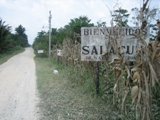
welcome to Salacuim

IMG_4010
a muddy hike through the jungle to Rocja Pomtila

IMG_4051
Courtney and Maria (scholarship sponsor)

IMG_4057
spending time in Salacuim

November 9, 2007

Benpec el Castaño, Historic Day

Today the neighboring town to Salacuim, Benpec el Castaño, held a ceremony where the community members received titles to their land after a long and arduous process. This town is only a 30 minute walk or a short bike ride from Salacuim, and Kari & I often go there to visit the river for swimming or just to pass time. Our Peace Corps site-mate Nicole works with a womens group from Castaño that makes hand woven fabrics. I've worked with their community association this year to form a group that was trained in the principles of community tourism. So this community is really part of our Peace Corps "site"; we've made friends and memories there.

It was special to see a group of farmers that have never owned land, achieve something that will benefit them and their future generations. As Guatemala has a long, long history of land rights struggles, it's encouraging to see that at least some local farmers are receiving the basic necessity to build a better future for their families: a title deed to their land.

Here are the few of the details of the purchase:
  • 75 families received land, all as part of an farmers association
  • each family will receive about 12 "manzanas" of land (about 21 acres)
  • Each family will pay subsidized price of Q11,800 over a maximum of 8 years for their land (through the local association)
  • The community will also receive support with various production projects to help them get started (pineapple, cacao, reforestation, cattle, and tilapia)
  • Their are about 1500 acres in the community, and the sale price (from a private owner to the government) was Q2,400,852.50. This implies that the land is worth about $210/acre.
IMG_3886

Guatemalan Units of Measurement

Guatemalans use the metric system, but they are still kind of trapped between rural farmers who still use their traditional units of measurement and influence from US English units. You buy gas by the gallon, drive stretches of road in kilometers, and you plant corn by the cuerda. Below is a list of distance and area measurements used in Salacuim, Guatemala.

Untitled-1

November 8, 2007

Scholarship Exam

We had a great turnout for the scholarship test that was given this week to all students in Salacuim that had completed 6th grade and have the desire to continue studying in 7th grade next year. The reality is that about half of these students won't be able to go to school next year, and essentially all of them will have difficulties finding money to buy supplies or uniforms.
So for many of these kids, doing well on this test and winning a scholarship through this program is the only chance they have to study next year.

Although several scholarship students will be grandfathered in this year, new students will all come from this group. The program hopes to select about 5 new scholarship students, depending on the success of fund-raising.

We are especially proud of how much the community collaboration has developed in a year. Last year, Kari and I picked scholarship students based on personal relationships and perceived needs. Right now, we have the support of teachers, community organizations, and of course the small committee that will be in charge of management after we leave; all supporting the dream to create a small, sustainable program that will create opportunities for children and develop leaders.


IMG_3851


IMG_3860

November 2, 2007

Something to Think About

With only five months left of service, I find myself trying to understand the situation Guatemala is in and what my future role can be. There is a strange feeling in knowing that I will someday leave and go back to a fairly comfortable lifestyle. I often feel guilty and at times very excited. It's a difficult balance. After living in Salacuim for nearly 2 years, I truly feel concerned for the people of my community and wonder what their future holds.

Currently Guatemala has the highest percentage of people living below the poverty rate in all of Central America at 56.2%. Extreme poverty is defined as living on less than $1 a day and moderate poverty is less than $2 a day.

Here are some interesting comparisons between Guatemala and the U.S.

Guatemala/United States
Illiteracy rate: 30.9%/1%
Infant Mortality rate: 29.7 of 1,000/6.27 of 1,000
Fertility rate: 3.7 per woman/2.09 per woman
HIV prevalence: 1.1%/0.6%
Population below poverty level: 56.2%/12%
Age structure: 1-14(40.8%) 15-64(55.5%) 65+(3.6%)/
1-14(20.2%) 15-64(67.2%) 65+(12.6)

Other Guatemalan Facts...

Average duration of schooling is only 4 years
Only 3 of 10 children graduate from 6th grade
More than 2 million children do not attend school
(mostly indigenous girls in rural areas)
Infant mortality rate is the highest in Central America and the 3rd highest in the hemisphere
50% of Guatemalan women have given birth before the age of 19
20% have 2 or more children by their 18th birthday
Contraceptive prevalence is 43%, the 2nd lowest in the hemisphere
49% of Guatemalan children under the age of 5 are chronically malnourished
Only 41% of births are attended by a doctor or nurse, lowest in the hemisphere

information provided by www.cia.gov, www.usaid.gov