August 31, 2007

The Stuff That Happens

IMG_3139

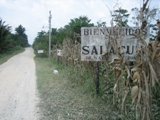
Last night Kari and our site mate Nicole were the judges in a mini beauty pageant in Salacuim. The event was aimed at selecting the "Novia del Ganadero", or the "Cattleman's Girlfriend" who will be involved in the upcoming rodeo in late September. The biggest highlight/lowlight of the afternoon was a toss-up between when the stage collapsed breaking a kid's leg, and when one contestant lost control of her galloping horse and almost trampled the crowd. The lowlights aren't really a laughing matter, but you can't help but see a general trend and compare/contrast to the States.

With about 7 months left before our scheduled return to "normal life", I've been thinking a lot lately about how precious every day of our experience down here is. I can't say that I enjoy the typical daily chaos I've learned to put up with: a shrieky blown-out speaker system pounding 20 feet from my desk on all day on a day when I had planned to catch up with computer work, or upsetting Kari with my inability to track and kill the huge spider with the egg-sack that had just climbed into her clean clothes pile, or the megaphone charged vehicles that decide to park on our street and blare presidential ads at 7am, or the holes in the office roof that send us running to cover everything up if a storm passes. (these are all events from today, except the spider which was yesterday)

But at the end of the day sometimes you just have to soak it all up and appreciate the experience as a whole, think about what a challenge you've overcome to adapt, cherish the soul-filling energy that comes with overpowering the daily obstacles, and be thankful for the stories that come with it.

Here are some more pictures from last night's event...

IMG_3140
The Judges


IMG_3137
The contestants

August 27, 2007

Children of the week

In about 2 months, students will be finishing up the school year in Salacuim. We have one final group of kids to highlight before the year is over; our other junior high group. They all attend a fairly new and private school in Salacuim. The classes are small and there are 3 teachers that switch off teaching different subjects. It's a little more structured than the telesecundaria and this will be the first year that they will graduate a class from the school. There is a lot of talk lately as to weather or not the school will be around next year. It was started up by a local family of teachers as another alternative to learning in Salacuim, but they are renting a building which will not be available next year and looking at a lot of costs that are keeping them down.

<span class=
name: Ofelia Xe age: 20 grade: 9th
favorite subject:
spanish favorite sport: basketball
future goal:
to be a teacher

Our town (or maybe Guatemala in general) has a reputation of making a lot of options for the same thing. Whether it's over 15 political parties on a ballot for president, 6 different churches of the same religion for our tiny town or 2 different junior highs, they like to divide rather than unite their efforts to make one outstanding system.

<span class= <span class=
name: Leobardo Pop age: 15 grade: 8th
favorite subject:
math favorite sport: soccer
future goal:
to own a business

This group of kids has presented a special challenge to us. Only by chance, within this group we are dealing with our only single teen mother, who is struggling to balance school and taking care of her child. We also have one girl who has lost her mother and lacks a female influence in a machismo society. The challenges have surfaced in terms of not having a sufficient elementary education to understand complicated junior high topics and the results have been low grades. For some reason we have had to push this group to excel more than others. They have all risen to the occasion though and we are hoping that this year will end in success for them.

<span class=
name: Narcy Ac age: 18 grade: 7th
favorite subject:
q'eqchi' (mayan language)
favorite sport:
soccer
future goal:
to be a teacher

<span class= <span class=
name: Ilce Choc age: 15 grade: 7th
favorite subject:
q'eqchi' (mayan language)
favorite sport:
basketball
future goal:
to be a nurse

Regardless of all the obstacles, they are all getting a second chance to succeed this year. An opportunity that would not have been there without outside donor support.

August 17, 2007

Forsberg Family Vacation

<span class=
Ruins of Quirigua

I grew up taking road trips across the country with my family. Every summer without fail we would load up the minivan and drive. Lately it's been more difficult to get everyone together and plan a big family trip. We all seem to be going in different directions, with different schedules. This year, the family came to us. For 10 days we experienced Guatemala and soaked up the culture and richness of the country together. For my parents, it was their first international trip and for Katie, who had already been here once and Mark, who had spent a month this summer studying in Honduras, it was still an adventure. We all saw things a little differently this time around. Even us, who have traveled this path many times over.

<span class=
Laguna Lachuá National Park

It was invaluable to have everyone come to our site and see what we have done since we arrived. It is one thing to email our stories, but another thing to experience them with us. At times, the steps seem immeasurable to us, but to see how we have changed and grown through someone else's eyes is refreshing. It was great to have them meet our neighbors and the kids that we spend time with. The individual students that they are sponsoring through the scholarship program, were all able to spend time with them and see that there is a real person on the other end that cares about what they are doing. It was a powerful interaction for the kids and my family.

<span class=
Meeting the scholarship kids they sponsor

Throughout the week and a half, we took in the sites of Antigua, Lake Atitlan, traveled to Salacuim and Laguna Lachuá, visited our host family in Santo Tomas, made the long drive up to Tikal National Park and spent a night in Rio Dulce. Every day was different and every day there was a new obstacle to overcome.
I really enjoyed watching the reactions to some of the things that we now consider fairly normal; a metal ladder leaning against an electrical line, a man climbing up the side of a bus to put something on top while it is moving down the highway, kids doing cartwheels at a stoplight for money and the lovely habit of throwing toilet paper in the wastebasket. It made me realize how much we have adapted in order not to notice these things and also how the readjustment back will be challenging.
This is a family trip that we will talk about forever. Whether it changed some viewpoints of those that came, or those that they met, it definitely impacted everyone in a different but important way.

<span class=
Tikal National Park

July 16, 2007

Children of the week

This is one group of our junior high students that are benefiting from the scholarships this year. There are two options for junior high in Salacuim. One school is private and tends to be a little more expensive with a smaller student to teacher ratio. The other school, called a telesecundaria, is what these students are attending. In the telesecundaria, the idea is for the schools to use video tapes made by the government to teach the classes. It cuts back on the costs of teachers and also allows the government to regulate the curriculum to some degree. This is a system that is used frequently in the rural areas of Guatemala. In Salacuim however, the televisions have broken and they no longer use this method. They continue to call themselves a telesecundaria but instead they have one teacher for each grade.

victor victor2
name: Victor Ical age: 14 grade: 7th
favorite subject: math favorite sport: soccer
future goal: to be an accountant


name: Warner Quib age: 14 grade: 7th
favorite subject: math favorite sport: basketball
future goal: to be a college graduate


If the kids make it to the junior high school level in Salacuim, it is quite an achievement. They have beaten some of the odds and are that much closer to a high school education, which is almost unheard of in the rural areas. If you are living in Salacuim, your education ends at 9th grade. From there it is similar to deciding on what colleges to attend for kids in the states. For a 15 year old, it can be a difficult decision to decide to leave home and study or stay with their family and work. Many of these kids will soon be faced with this same question.

yadira
name: Yadira Sagui age: 18 grade: 7th
favorite subject: math favorite sport: soccer
future goal: to be a college graduate


zuni
name: Zunilda Chen age: 15 grade: 8th
favorite subject: math favorite sport: soccer & basketball
future goal: to be a college graduate


<span class= <span class=
name: Julio Paau age: 15 grade: 9th
favorite subject: math favorite sport: soccer & basketball
future goal: to be an engineer


The work load is much more demanding at this level of schooling. The students are taking 10 different classes and also have a mandatory typing class that they must attend 20 hours a month outside of school. At this age they are also responsible for doing many of the adult duties in their family as well. For the boys, this would generally involve field work. The girls mostly work in the home cooking and cleaning. Aside from the demands being higher, the costs also double from the costs of elementary school. For many families it is not financially possible to think about junior high. Luckily all of these kids are benefiting from your support this year.

July 10, 2007

Salvador

One of the amazing things about being a Peace Corps Volunteer is being able to see the world. Not just where you serve, but all around you. We had a great trip to El Salvador last week. Beautiful beaches, friendly people and American dollars. It felt like home.

128_5927

beauty

128_5941

tranquility

128_5955

solitude

128_5944 copy

June 15, 2007

Dream of a Community Library

The community of Santa Lucia Lachuá is a 30 min trip from Salacuim and is home to an incredibly motivated and organized group of leaders as well as a robust school system that includes a teachers school (magisterio). We have enjoyed working with the community and are supporting and encouraging their request to host a Peace Corps volunteer after we leave the region in April of 2008.

In February the community submitted a proposal for a community library project to the "Peace Corps Partnership Program", where the Peace Corps in Washington publishes and advertises community projects to corporate sponsors and regular givers. The idea is that the givers enter a "partnership" with the community and receive communication directly from the people that benefit from the gift throughout the project. Unfortunately, the project has not received funding as quickly as we would have hoped. The project needs to receive funding within 2-3 months or they won't be able to complete the construction before we leave in April 2008.

Below is a link to a detailed project profile in PDF as well as a link to the project profile website (where donations can be made).

If anyone out there knows of potential donors (businesses, corporations, etc.) or any other creative funding ideas, please contact us!

Proposal for the Community Library (1.25 MB)
Peace Corps Website Promoting the Project


2
Youth group during planning meeting

IMG_2565
Judging an environmental art competition in Santa Lucia Lachuá

1
Joint Youth Group / COCODE meeting in Santa Lucia Lachuá

Child of the week

100_4041
name: Ingrid Caal
age: 9
grade: 1st
favorite subject: spanish
favorite sport: soccer
future goal: to be a teacher


Sometimes is is hard to see the direct academic impact that our scholarship program has on the kids. We know that all the children in our program could not have studied this year without outside help. We can see that they are in school and now part of something academic, but are they succeeding and thriving? The school system in Salacuim is a long ways from being known as the best of the best, but you work with what you have.

IMG_1965
first ever school supplies

Ingrid has been one of the rare transformations to watch academically. At 9 years old, she was given the chance to go to school for the first time in her life. Being from one of the poorer families, she had never been able to attend the last three years that she was eligible. In the last 5 months, we have seen her go from only being able to draw pictures to express herself to writing words and sentences. She is now able to read and write at a basic level. A level which is well beyond what her mother is at. To me, that is progress. To see huge steps like this being taken in a short amount of time is the definition of why we are doing this program. Ingrid gives us some hope that we are doing the right thing and making a positive contribution to the way people think about education here.

In Salacuim and perhaps rural Guatemala in general, girls quickly become labeled as future mothers and wives that will take care of the home and have no need to be educated. We hope to break some of this cycle by starting young and giving the girls a chance to explore and succeed before they are consumed by years of tradition. Ingrid is now setting the example for her two younger sisters and living the dream of her mother to be an educated adult.

121_4886
ingrid, mom and sisters

June 8, 2007

Top 10

There are many mornings when I wake up and wonder what it is I am doing and accomplishing here. While there are frustrations, there are also things that I cannot imagine living without that I have discovered during our time in Salacuim. Each day makes me appreciate the little things.
A common first reaction when visiting a third world country or a very poor area tends to be focused on the surface ugliness. Whether it be the extreme poverty, trash everywhere or lack of hygiene practices. It takes a long time to see beyond what we are trained to see as beautiful. I think I have reached the point where I can look beyond the surface and see what lies beneath. An enormous amount of potential and one amazingly BEAUTIFUL place.

my top 10 of Salacuim ...
sonia park DSC03659
hugo river jungle shower ride
pina mainstreet hammock2
the faces, laguna lachuá national park, time together, at your door service, chixoy river,
jungle shower, the ride, fresh pineapple, main street, hammocks

June 1, 2007

Ropa Americana

Friday is shopping day in Salacuim. The fresh produce usually comes in Thursday night and the big truck full of ¨ropa americana¨ (american clothes) pulls up early Friday morning. It's an exciting time for the people of this small aldea. It's a good chance to socialize with your neighbors while buying your supplies for the week and checking out the latest fashions to come into Salacuim. For us, it's kind of like a day at Goodwill. The people here are firm believers that clothes from the states are of the best quality even if the majority of them are a flashback from the 90's. They seem to stand up to the test of getting scrubbed in a cement sink day after day. The trucks pull up and do their routine drop of piles of clothes on the ground, to which everyone dives in to see what they can find. Simultaneously, there is usually a man on the microphone calling out the deals like a cattle auction. Typically, you can find a good t-shirt for about Q4 or $0.35. Of course the shopping day inevitably ends up with a grown man buying a t-shirt that says, ¨I'm a big sister¨ or an 80 year old wearing a ¨Class of 2006 shirt¨. It provides for much humor and really makes the day what it is.

100_5782
The ¨pile¨

May 23, 2007

"La Siembra"

121_5597

The economy of Salacuim is completely based on agriculture and the majority of the activity is centered around corn. We live in a special area of Guatemala because it's possible to get two corn harvests per year, where the majority of the country can only get one.

To help describe how important corn is to the people here, "La Gente de Maiz" (translated: the people of the corn) is a common nickname for Guatemalan people. The word for the ever-present corn tortilla in the native Q'eqchi' language, "wa" is the same as the verb "to eat". Basketball practice can be canceled if the concrete court is being used for corn drying. Each family sends a mother, grandmother, or daughter with a bowl full of corn to the gas powered "molinas" (corn-grinders) three times a day to make "masa" (corn paste) for the tortillas for the meal.

This morning I was invited to help with "la siembra" (planting) of our neighbor's plot of land. I felt honored to be able to help with an activity I found to be rich in tradition. The custom is to eat breakfast with the land owner in the morning and work until the planting is done. When the work is finished, all are invited to share in the "caldo de gallina" (chicken soup) lunch which is the popular celebration dish for people here.

The work was all by hand. Only using a 2 meter long stick with a metal point on the end to pierce a hole in the ground and an over the shoulder bag to hold your seeds. It takes a little practice to throw your seeds in the tiny hole with out leaning over, but I figured it out after an hour or so. We were 6 "sembradores" (planters) to cover 12 "cuerdas" (roughly 21 square meters, or about 25 "varras" in local measurements), and it took us about a half of a day to finish the job. If I had been a hired worker, I would have earned 15 quetzals, or just over 2 dollars for my work.

Here are some pictures of the action:

121_5616
"El Sembrador"

121_5598
Teodoro with his perfect, consistent seed pitch.