Showing posts with label by Corby. Show all posts

January 25, 2009

New School Year Starts in Salacuim

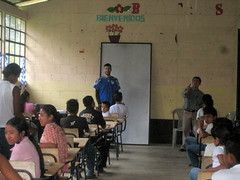
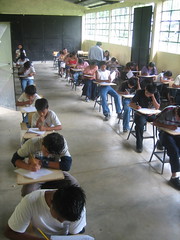
A new school year in Salacuim is already underway. The program welcomed 3 new 7th grade students as scholarship winners. All of the graduating 6th graders took a test to vie for a coveted junior high scholarship. For many of the students in Salacuim, gaining a scholarship like this is their only chance to continue studying beyond 6th grade.

Congratulations to:

  • Helmut Román Leal Oxom
  • Blanca Quinillo Castro
  • Marlin Floridalma Caal

More updates to come.......

September 6, 2008

Leaving Salacuim


Our time was up in Salacuim, we had to go. You can't really sum up what the experience has meant to you with words, how much it has formed you and helped you grow.

It was hard to leave, sad to say goodbye to friends: the kids that came to be so important to us, the customs. In the last weeks and days I wanted to savor it all, experience all the quirks of village life one last time--stretching out the 5 block walk from the NGO office to our house in to a 2 hour series of random visits instead of the usual 1 hour, joking around with my young buddies who loved to call me mamaá (the q'eqchi' word for old man) and wondering why the same old joke never got old, the afternoon tortrix® and elojito® snack breaks with Kari in the hammocks, the early morning fresh milk deliveries from our friend Hugo Tista on his horse that served as my alarm clock and daily weather report, the visits from Carlos Macz that never seemed to have a purpose, but always seemed to last at least an hour anyway, all of the visits from the group of neighbor girls that especially admired Kari and watching them play Uno or Jenga or draw pictures. Of course sometimes they just liked to stare at us and our strange foreign customs: cooking, washing clothes, reading books. How strange they thought we were:

¿Que es esto? ................A headlamp
¡Que bonita su reloj! ......An $8 Target special
¿Que es esto? ................A garlic press
¡Tienen 3 bombillas! .....The extravagance and excess of our lifestyle

I also wanted to absorb for one last time, all the special daily experiences that life in Guatemala had afforded me. The meals at the local comedor where the Medina's treated us like family and we felt the camaraderie with co-workers from the local NGO. The trips in the "poprocho", the old Toyota that always need a good shove and a slight incline to get started. This was the same vehicle that tossed the driver around like a rag doll on every bump as the seat wasn't attached to the rusted frame. The trips to the river, walks in the jungle, our outdoor jungle shower that was oh-so sweet in the warm evening air, unannounced visits to families where we were always greeted warmly and offered food or drink and made to feel like we were important, celebrations where we were given a big bowl of Caldo de Gallina, the pinnacle of local fine dining. Of course the Caldo was hard for us to choke down, and if I finished mine, Kari would always have seconds to put on my plate when no one was looking: This was all part of the experience!

I'm proud of what we accomplished during our 2 years in Salacuim. During our time there, we motivated and organized a local group to take steps toward development an income generating eco-tour of their community including a boat trip through "el Peyan" canyon, we trained leaders from the local youth group in grant writing and community project planning which cumulated in a project to improve the community library which was planned and executed by the youth group members themselves, we made connections with individuals in the US to make it possible for 19 local students to go to school in 2007 and 14 in 2008 through a scholarship program that will live on past our peace corps tour, we helped to plan future tourism in the Laguna Lachuá National Park (including new interpretive signs, remodeling of the eco-hotel, and the purchase of kayaks that are available for rent), we developed a website promoting sustainable tourism in the Laguna Lachuá region, and we work on lots of smaller projects that we hope made some kind of positive impact for the rural indigenous village of Salacuim where we served.

But that list of projects isn't what we did.

Although it sounds like a cliché, what was so much more important than the projects we worked on were the less tangible things...

We took walks over the dark muddy paths to visit families in the evening. We spent Christmas eating more than the recommended number of tamales with some of our favorite families. We spend several early mornings sitting 30 people deep in the 4:00 AM van built for 15 people to make a trip to Cobán trying to sleep despite the blaring ranchera hits such as "el chofer" or "tin marin" or "te vas arrepentir" over the bumps, mud, and flat tires. We sat and visited with families and friends in their humble homes and felt a part of something, a community.

December 11, 2007

Cell Phones coming to Salacuim!

We've been hearing rumors for at least a few months now that the cell phone companies have been visiting the area around Salacuim and doing feasibility studies. Obviously, we've been anxious to see if the rumors are true. We've lived here for almost two years now, always with limited communication. There are a few public telephones that grab a cell phone signal with a large antenna from distant cell towers, but the result is always a scratchy connection and a 65 cent/minute charge to call the US. There is also a telephone at our NGO's office which works on a satellite connection, but its plagued by a 2 second delay and strict limits on personal calls (especially frustrating when speaking Spanish as a second language).

Also, about six months ago some new towers went up across the Chixoy River in the Quiche department that gave everyone a sort of hope that maybe their phones could grab signal in special "spots", in fact the large open field next to our house has had a faint signal if you stand in the right place for enough time and learn the tricks such as shutting-of and restarting your phone 3 times in succession while raising your left hand in the air. This ghost signal has created a culture of small groups that congregate in these "spots" with their phones every night, partially to make phone calls but also to pass time.

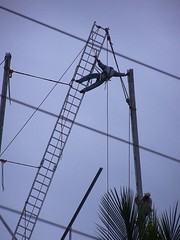
This is all about to change, as this week we noticed a large metal object growing in Salacuim's skyline, a shiny new cell phone tower! The rumor is that we will have real cell phone signal before Christmas. A team of 6 Colombian and Nicaraguan workers (better described as Trapeze artists) are throwing up a 130 meter tall tower that promises cheap, clear phone calls and the ability to actually receive calls in the last few months of our Peace Corps Service.

Construction Methods:
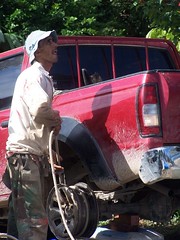
Although these guys don't have all of the safety gear required in the US, I'm impressed with their use of resources. There is no crane, but they can secure a metal section of ladder to the tower with rope and use it as a boom. From there they run a rope through a pulley system to the rear wheel of a pickup truck up on blocks. To lift sections of the tower, they start the pickup, put it in gear and use it as a crane.

Development:
An adviser to our NGO talks about development of the area as a balance between infrastructure, education, political organization, and environmental conservation; calling them the 4 "capitals". Things like education and political organization are just as important to the development of Salacuim, but they are intangible, hard to see, and actually take more time.

Infrastructure, however, is very tangible and visible. We arrived in Salacuim about 10 years after they were connected to Cobán with a gravel road. The electricity came about 4 months before we arrived, and a previous Peace Corps volunteer told us about the drastic difference: TV's, later nights on the street, etc. Earlier this year, all of the side streets were leveled and lined with gravel; a huge improvement to the steep, slippery paths of before. Offices have also been built for the local organizations: the youth group, the farmers group, and the womens group. In the near future, running water and road paving projects are in the works. We have to look at how much the face of this area is changing and just be amazed.

100_4053
Tower construction acrobatics

100_4059
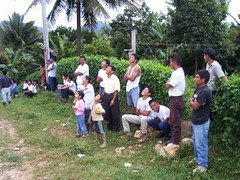
The tower construction site is the most popular community gathering spot

100_4045
Use of pick-up as a crane


December 1, 2007

Lunch with the Senators

During Joey and Stacie's visit, we got a phone call from the Peace Corps office inviting us to have lunch with a delegation of US Senators that were in the midsts of a tour, meeting with presidents of several South American and Central American countries during the Senate's Thanksgiving recess. Only 6 Peace Corps volunteers were invited, including us because I happen to be the only PC volunteer in Guatemala with North Dakota roots and both senators from North Dakota were part of the delegation.

Kari and I were split between tables, my place was with the ND senators while Kari was with the Senate Majority Leader Harry Reid and the US ambassador in Guatemala. It was a unique experience for me to have lunch at a small table with 2 senators and their wives. I was impressed at how interested they all were about the life of a Peace Corps volunteer, and I think my Dad was just as impressed when he received a personal phone call from Byron Dorgan the day afterwards to let him know that his son was doing well in Guatemala.


100_3980
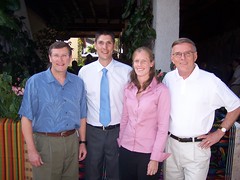
Kari & I with North Dakota Senators Kent Conrad and Byron Dorgan

100_3978
Kari & I with Senate Majority Leader Harry Reid

November 30, 2007

After-Thanksgiving Visitors: Lewis family

After a visit from Courtney & Eric, we got to be hosts for another week for the long awaited visit from my brother and sister: Joey and Stacie. We had a great time, catching up with their lives and showing them around a few places we know in Guatemala. The highlight of the trip was the 3 days we spent in Salacuim, although we had some bad luck with heavy rains while they were here. We also had the chance to visit with our original host family (for the first 3 months of Peace Corps training, way back in January of 2006) and climb an active volcano. Here are some the pictures from their trip.

IMG_4116
Lewises at Sachicha Waterfall

100_3956
At our house in Salacuim

IMG_4110
With the kids from our original host family


Lewises on Pacaya Volcano

DSCN1359
Lewises at the Biotopo del Quetzal

November 9, 2007

Benpec el Castaño, Historic Day

Today the neighboring town to Salacuim, Benpec el Castaño, held a ceremony where the community members received titles to their land after a long and arduous process. This town is only a 30 minute walk or a short bike ride from Salacuim, and Kari & I often go there to visit the river for swimming or just to pass time. Our Peace Corps site-mate Nicole works with a womens group from Castaño that makes hand woven fabrics. I've worked with their community association this year to form a group that was trained in the principles of community tourism. So this community is really part of our Peace Corps "site"; we've made friends and memories there.

It was special to see a group of farmers that have never owned land, achieve something that will benefit them and their future generations. As Guatemala has a long, long history of land rights struggles, it's encouraging to see that at least some local farmers are receiving the basic necessity to build a better future for their families: a title deed to their land.

Here are the few of the details of the purchase:
  • 75 families received land, all as part of an farmers association
  • each family will receive about 12 "manzanas" of land (about 21 acres)
  • Each family will pay subsidized price of Q11,800 over a maximum of 8 years for their land (through the local association)
  • The community will also receive support with various production projects to help them get started (pineapple, cacao, reforestation, cattle, and tilapia)
  • Their are about 1500 acres in the community, and the sale price (from a private owner to the government) was Q2,400,852.50. This implies that the land is worth about $210/acre.
IMG_3886

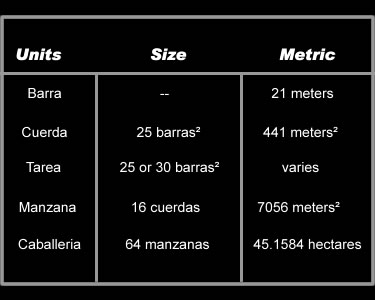
Guatemalan Units of Measurement

Guatemalans use the metric system, but they are still kind of trapped between rural farmers who still use their traditional units of measurement and influence from US English units. You buy gas by the gallon, drive stretches of road in kilometers, and you plant corn by the cuerda. Below is a list of distance and area measurements used in Salacuim, Guatemala.

Untitled-1

November 8, 2007

Scholarship Exam

We had a great turnout for the scholarship test that was given this week to all students in Salacuim that had completed 6th grade and have the desire to continue studying in 7th grade next year. The reality is that about half of these students won't be able to go to school next year, and essentially all of them will have difficulties finding money to buy supplies or uniforms.
So for many of these kids, doing well on this test and winning a scholarship through this program is the only chance they have to study next year.

Although several scholarship students will be grandfathered in this year, new students will all come from this group. The program hopes to select about 5 new scholarship students, depending on the success of fund-raising.

We are especially proud of how much the community collaboration has developed in a year. Last year, Kari and I picked scholarship students based on personal relationships and perceived needs. Right now, we have the support of teachers, community organizations, and of course the small committee that will be in charge of management after we leave; all supporting the dream to create a small, sustainable program that will create opportunities for children and develop leaders.


IMG_3851


IMG_3860

October 15, 2007

Ecoregión Lachuá

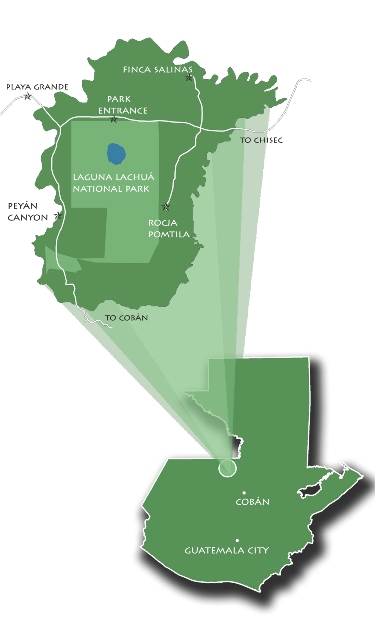
Ecoregión Lachuá is where we work. Kari made this map as part of some new eco-tourism promotional material.
map layout

October 14, 2007

Álvaro Colom Visit to Salacuim

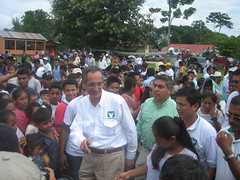
Guatemala is in the heat of a campaign leading up to it's presidential elections on November 4. Salacuim history was made today when this small aldea of 2,500 people received its first ever presidential campaign visit from Álvaro Colom. He came in a helicopter, talked for about an hour and then his team accepted letters of request from community members seeking community projects if he were to become president. Afterwards, there was squabble around the truck that was throwing out 50 cent bags of kool-aid and little pieces of bread to the locals.

IMG_3817

October 12, 2007

Carpe Diem Visit to Lachuá

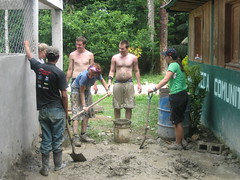
Last week we had the good fortune to be hosts to a group of 15 Americans that came for a week long visit to Laguna Lachuá and Salacuim. They came with a ton of energy and willingness to contribute to community projects in the area. They were in week 4 of a 3 month long trip through Guatemala, Honduras, and Costa Rica (link to their blog); all of them learning to speak Spanish and doing community service along the way. I think they all really enjoyed being in our area: visiting the Laguna Lachuá Park, learning about the hand made weaving from TESA (women's group that Nicole works with), working really hard pouring a cement floor in the youth group construction project, harvesting corn with a local farmer, helping to clear weeds from a reforestation project, sifting dirt for the tree nursery, and helping out on a Tilapia farm.

We felt lucky to host such an active group and watched a wonderful exchange of cultures between the locals and the visitors. Most of all I also enjoyed playing in a competitive basketball game with people taller than me.

IMG_3757
Helping mix concrete by hand

IMG_3742
Learning how to weave

October 8, 2007

Trip to Chiapas, Mexico

We've been bogged down with work lately and feeling like our "Close of Service" date that is only about 6 months away is looming, as we're trying to complete various projects. I recently finished up a community tourism training class with a group young people from the neighboring town of Benpec el Castaño which had been keeping us tied down every Saturday for the last few months. We are also pushing to finish a construction project, where the local youth group (JAGUAR) is adding on a study space to their community library. We are in the thick of organizing the scholarship program for the school year that starts next January. Kari is busy with designing some eco-tourism promotional material and website improvements for the Laguna Lachuá National Park. Kari and Nicole have had a few meetings to try to create a young girls group to help promote leadership and self-esteem. Of course there are lots of other important community project ideas that have always been delayed, with the thought "we'll have more time for that later".

I'm also thinking about trying to soak up as much as I possibly can from our precious little remaining time....I've never taken the hike to Rocja Pomtila from Salacuim through the thick of the jungle, I haven't learned more than basic conversations in the Q'eqchi' language, we've never traveled to Xela on the other side of the country, I've only hiked up 1 of the 20 volcanoes higher than 2000 meters in Guatemala.

So, last weekend we made a quick get away to Chiapas, Mexico with our site mate Nicole. I had heard about a National Park called the Lagunas de Montebello that wasn't supposed to be very far from our site. We left early in the morning on Saturday and got to a town called Tziscáo in the afternoon. On the way we crossed the dusty, unmanned border crossing near the town of Ingenieros, Guatemala and spent the rest of the weekend wondering if anybody would check for a stamp in our passports. The Mexican side of the border greeted us with paved roads, a nearly empty micro-bus, and a semi-cautious driver (now that's what I call a developed country). The scenery was beautiful and we found a little cabin to stay at right next to a sweet little lake. Here are a few pictures from the trip....

IMG_3717
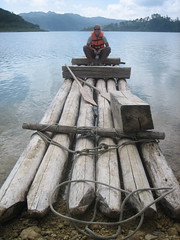
Kari on one of the famous rafts made from the local cork trees.

IMG_3704
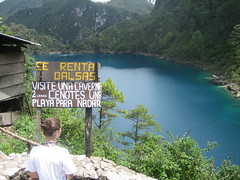
View from 5 Lakes lookout

IMG_3686
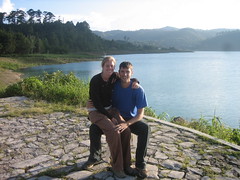
Kari and I at one of the lakes

September 26, 2007

City Duck, Country Duck

Recently, the stories of two ducks with similar, gloomy fates have recently served to compare and contrast the differences between cultures.

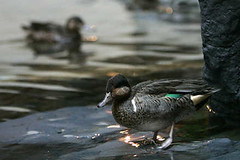
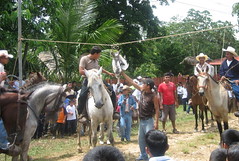
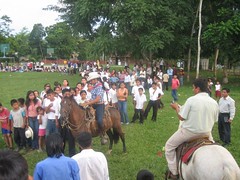
This past weekend a domestic duck living in an ornamental pond in a high-society downtown St. Paul Minnesota hotel(our hometown before we came to Guatemala) was brutally attacked by a hotel guest that apparently ripped its head off in the hotel lobby informing the other guests that he was hungry. Farther to the south in rural Guatemala, we were witnesses this week to a "pato encebado" contest as part of a local celebration where a group of cowboys hung a living duck up by its legs and then shaved and greased its neck; all of this with the objective to take turns attempting to pull its head off with their hands during passes on their galloping horses.

The real lesson in all of this is found in the reactions of the society. In St Paul, the assailant is facing a felony with up to two years of jail time and a $5,000 fine while a high class hotel is considering some sort of increased security or fencing system to protect the rest of their ducks. In our town, the winner of the contest was awarded a prize of Q200 and much of the normally very reserved indigenous crowd really got their spirit up with shouts such as "¡arranquela hombre!"
hotel duck
City Duck

IMG_3578
Country Duck

Read story of St. Paul Hotel Duck: http://www.startribune.com/462/story/1440073.html

August 31, 2007

The Stuff That Happens

IMG_3139

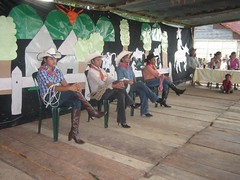
Last night Kari and our site mate Nicole were the judges in a mini beauty pageant in Salacuim. The event was aimed at selecting the "Novia del Ganadero", or the "Cattleman's Girlfriend" who will be involved in the upcoming rodeo in late September. The biggest highlight/lowlight of the afternoon was a toss-up between when the stage collapsed breaking a kid's leg, and when one contestant lost control of her galloping horse and almost trampled the crowd. The lowlights aren't really a laughing matter, but you can't help but see a general trend and compare/contrast to the States.

With about 7 months left before our scheduled return to "normal life", I've been thinking a lot lately about how precious every day of our experience down here is. I can't say that I enjoy the typical daily chaos I've learned to put up with: a shrieky blown-out speaker system pounding 20 feet from my desk on all day on a day when I had planned to catch up with computer work, or upsetting Kari with my inability to track and kill the huge spider with the egg-sack that had just climbed into her clean clothes pile, or the megaphone charged vehicles that decide to park on our street and blare presidential ads at 7am, or the holes in the office roof that send us running to cover everything up if a storm passes. (these are all events from today, except the spider which was yesterday)

But at the end of the day sometimes you just have to soak it all up and appreciate the experience as a whole, think about what a challenge you've overcome to adapt, cherish the soul-filling energy that comes with overpowering the daily obstacles, and be thankful for the stories that come with it.

Here are some more pictures from last night's event...

IMG_3140
The Judges


IMG_3137
The contestants

June 15, 2007

Dream of a Community Library

The community of Santa Lucia Lachuá is a 30 min trip from Salacuim and is home to an incredibly motivated and organized group of leaders as well as a robust school system that includes a teachers school (magisterio). We have enjoyed working with the community and are supporting and encouraging their request to host a Peace Corps volunteer after we leave the region in April of 2008.

In February the community submitted a proposal for a community library project to the "Peace Corps Partnership Program", where the Peace Corps in Washington publishes and advertises community projects to corporate sponsors and regular givers. The idea is that the givers enter a "partnership" with the community and receive communication directly from the people that benefit from the gift throughout the project. Unfortunately, the project has not received funding as quickly as we would have hoped. The project needs to receive funding within 2-3 months or they won't be able to complete the construction before we leave in April 2008.

Below is a link to a detailed project profile in PDF as well as a link to the project profile website (where donations can be made).

If anyone out there knows of potential donors (businesses, corporations, etc.) or any other creative funding ideas, please contact us!

Proposal for the Community Library (1.25 MB)
Peace Corps Website Promoting the Project


2
Youth group during planning meeting

IMG_2565
Judging an environmental art competition in Santa Lucia Lachuá

1
Joint Youth Group / COCODE meeting in Santa Lucia Lachuá

May 23, 2007

"La Siembra"

121_5597

The economy of Salacuim is completely based on agriculture and the majority of the activity is centered around corn. We live in a special area of Guatemala because it's possible to get two corn harvests per year, where the majority of the country can only get one.

To help describe how important corn is to the people here, "La Gente de Maiz" (translated: the people of the corn) is a common nickname for Guatemalan people. The word for the ever-present corn tortilla in the native Q'eqchi' language, "wa" is the same as the verb "to eat". Basketball practice can be canceled if the concrete court is being used for corn drying. Each family sends a mother, grandmother, or daughter with a bowl full of corn to the gas powered "molinas" (corn-grinders) three times a day to make "masa" (corn paste) for the tortillas for the meal.

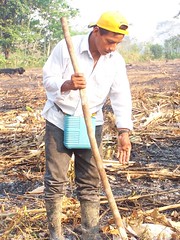
This morning I was invited to help with "la siembra" (planting) of our neighbor's plot of land. I felt honored to be able to help with an activity I found to be rich in tradition. The custom is to eat breakfast with the land owner in the morning and work until the planting is done. When the work is finished, all are invited to share in the "caldo de gallina" (chicken soup) lunch which is the popular celebration dish for people here.

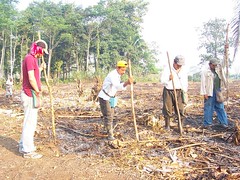
The work was all by hand. Only using a 2 meter long stick with a metal point on the end to pierce a hole in the ground and an over the shoulder bag to hold your seeds. It takes a little practice to throw your seeds in the tiny hole with out leaning over, but I figured it out after an hour or so. We were 6 "sembradores" (planters) to cover 12 "cuerdas" (roughly 21 square meters, or about 25 "varras" in local measurements), and it took us about a half of a day to finish the job. If I had been a hired worker, I would have earned 15 quetzals, or just over 2 dollars for my work.

Here are some pictures of the action:

121_5616
"El Sembrador"

121_5598
Teodoro with his perfect, consistent seed pitch.

May 20, 2007

Peace Corps Photographers

We take some snapshots of our ¨Peace Corps Experience¨ here in Guatemala. They are great memories and a few of them turn out really nice. However, there are some top notch P.C. photographers here and they are capturing images similar to what we see here but in a much more artistic and eye appealing way.

Check out these site if you want to see some good PC guatemala pictures--

http://www.flickr.com/photos/jonathanmiller/

DSC03112


http://www.flickr.com/photos/43918028@N00/

DSC03112

May 3, 2007

Chicken Bus Photo Essay

The chicken buses are famous in Guatemala. These converted American school buses are the main form of transport around the country and are known for being so full that people hang out of the windows and doors. Check out this website for some more info and pictures.
Chicken Bus Page
Chicken Bus Photo

March 20, 2007

Milk Delivery

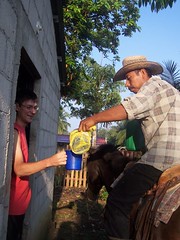
Lately the routine has been to wake up at 6:30 to the sound of a horse trotting up to the front door and a "buenas dias" from our neighbor and friend Hugo. Since he's had his calves (both of them), he arrives to deliver our liter of fresh milk 6 days a week. It's a good time of the day to talk about the weather and learn a new spanish or q'eqchi' word.
I don't think we'll be able to find this kind of service when we're back in the states. When you eat bananas from your backyard with fresh cream and local honey, its hard to find a reason why you'd want to go back.

121_5083